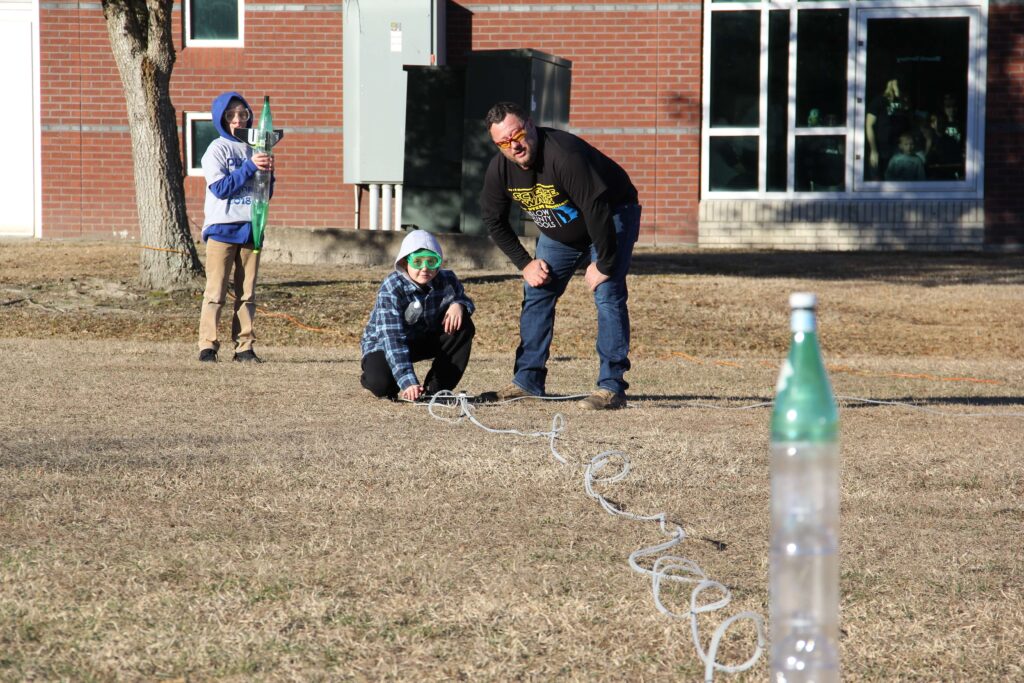
Egg-O-Naut
Division: A – Elementary
NC Essential Standards Alignment: PS.3.1, PS.5.1, Science as Inquiry
SEP Practices: Asking Questions and Defining Solutions; Constructing Explanations and Designing Solutions
Description:
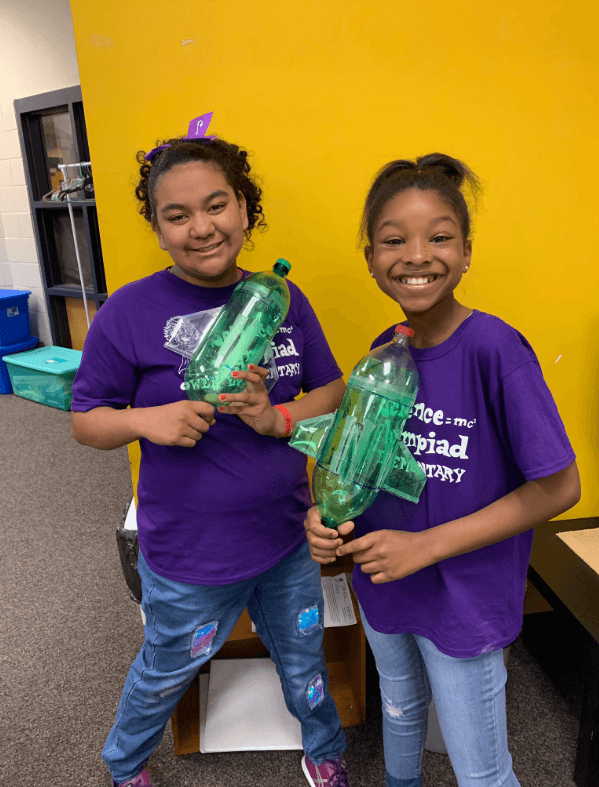
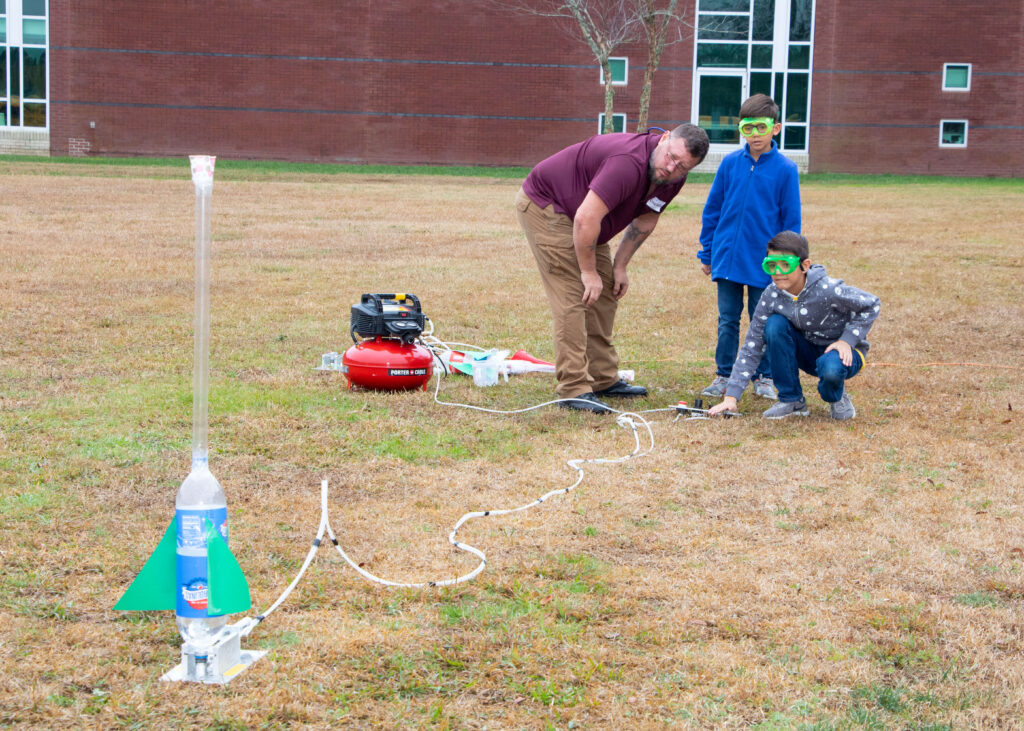
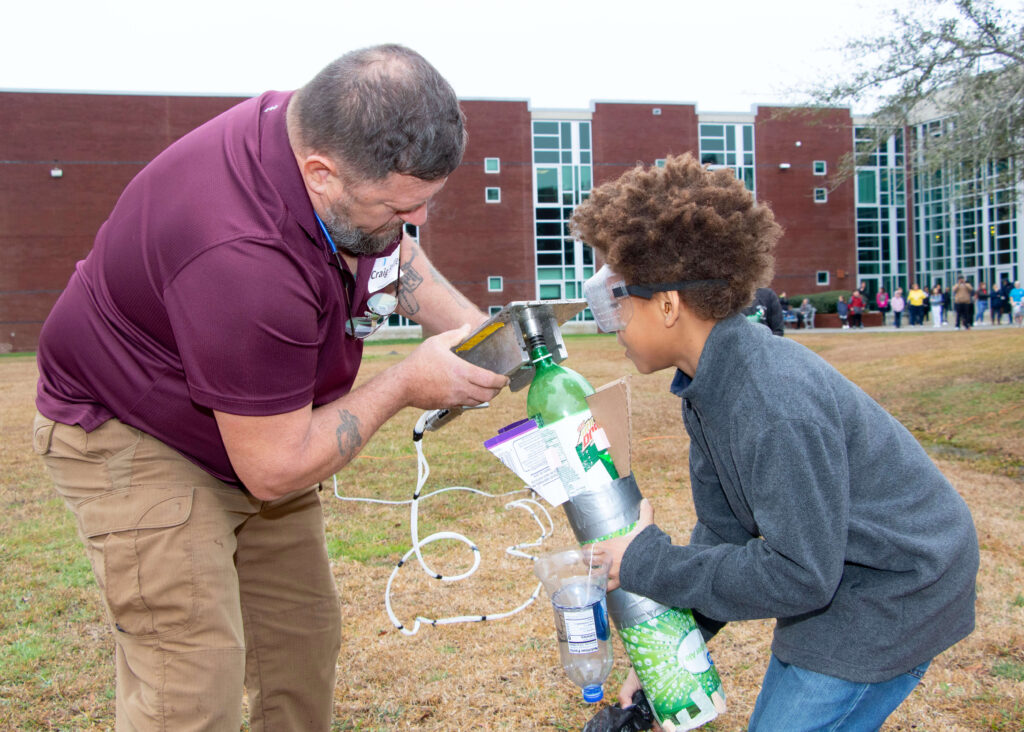
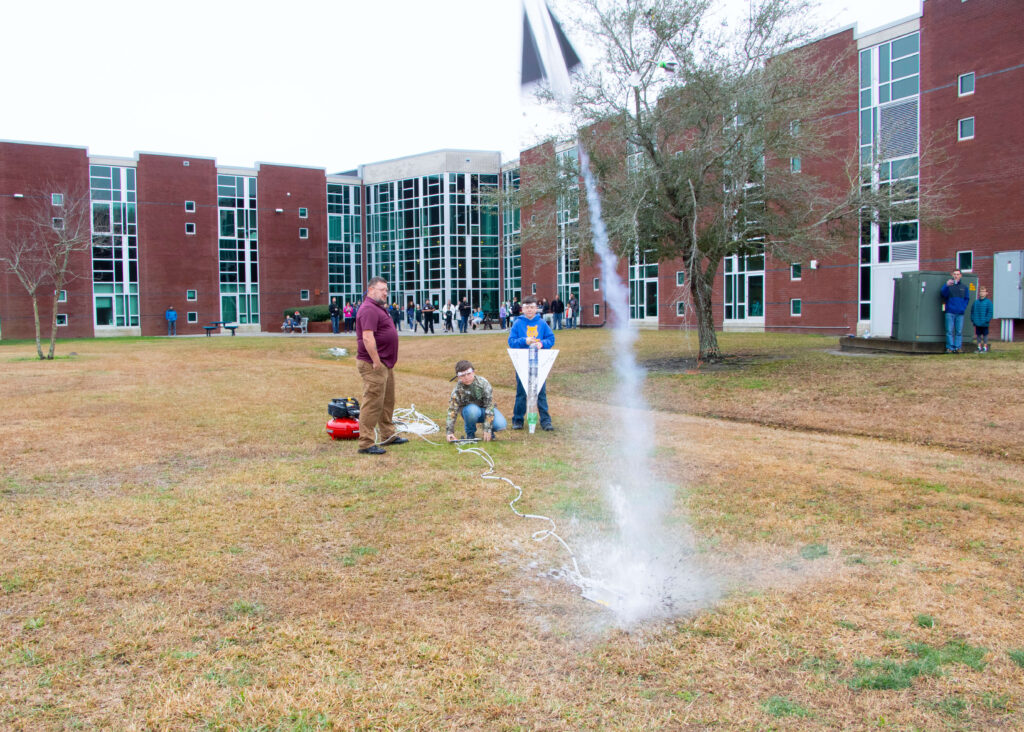
Prior to the tournament, teams will construct up to two rockets designed to stay aloft the greatest amount of time while carrying an Egg-O-Naut (a raw Grade A large chicken egg) that survives (doesn’t break) on impact.
Materials:
Teams must bring up to two rockets, constructed prior to the event, carbonated beverage bottle labels (if removed) and safety glasses. Teams may also bring funnels, measuring cups, and/or other tools to help prepare their rockets.
FAQs & Clarifications:
1/15/26: Inclement Weather Plan: The event runs unless there is thunder or lightning or the Event Leader determines the wind/rain is too strong to safely run the competition. Otherwise, the event runs since everyone experiences the same conditions.
10/21/25: Will an air compressor or a bike pump be used for launch?
Either can be used – regardless, rockets will be launched at 60 psi.
10/21/25: Rules for Egg-O-Naut were updated as follows:
After going through everything this weekend at the Coaches Conference, it became apparent that we needed to make some clarifications and rule changes to the Egg-O-Naut event. Here are those changes:
- Having the Egg-O-Naut (or portion contain the egg) completely detach from the pressure vessel will result in a 10 second bonus.
- Eggs that can be retrieved and survive will receive a 5 second bonus.
- Any launch with non-safety violations will receive a -5 second penalty (negative scores are possible).
- This will no longer be a Tiered event.
- Tiebreakers: First tiebreaker is the better score of each tied team’s other rocket launch. If you have two tied teams and one launched a second rocket, and the other did not then the team that launched a second rocket wins the first tie breaker. Second tiebreaker is team with the most bonus points. Third tiebreaker is averaging the times of the three timers for the launch and the lowest average time score wins.
Scoring:
- Rockets that violate a safety-related rule under Construction Parameters will not be launched and will receive participation points only.
- Any launch with competition violations, or non-safety construction violations will receive a -5.00 second penalty. (negative scores are possible)
- Any Egg-O-Naut (or portion of the rocket containing the egg) that completely detaches from the pressure vessel will receive a 10 second bonus. Rockets whose parts (e.g. fins) do not remain linked while aloft will not be disqualified or penalized.
- Eggs that can be retrieved and survive will receive a 5 second bonus. An egg’s survival is defined as not cracking the egg enough to leave a wet spot on a paper towel. An Egg that cannot be retrieved will not receive this 5 second bonus.
- The score for each rocket launch will be equal to its time aloft plus bonus seconds for Egg-O-Naut capsule separation (+10.00 second bonus) plus bonus seconds for Egg-O-Naut survival (+5.00 second bonus) minus penalty seconds for competition or non-safety violations.
- Ranking is determined by the greatest time aloft for one rocket flight. Rockets that cannot be tested for any reason (e.g. safety issue, does not fit on launcher, etc) will be given participation points only.
- Tiebreakers: First tiebreaker is the better score of each tied team’s other rocket launch. If you have two tied teams and one launched a second rocket, and the other did not then the team that launched a second rocket wins the tie breaker. Second tiebreaker is team with the most bonus points. Third tiebreaker is averaging the times of the three timers for the launch and the lowest average time score wins.
Common Mistakes:
- Be sure that the pressure bottle remains intact. Repeated testing and hard landings can damage your pressure bottle. Check it frequently for scratches and weak spots that may compromise the structural integrity, and replace the bottle as needed.
- Find the ideal water level for your rocket. While 100% air will give you the maximum potential energy, it has very little mass and therefore very little momentum to carry the rocket. Likewise, 100% water will have great mass, but very little potential energy to give it momentum. Don’t wait until the day of the competition to decide how much water to use!
- If you remove the label from your pressure bottle, be sure to bring it to the competition or you will not be allowed to launch the rocket.
- Remember, only one launch is allowed per rocket! If you want to use both launch attempts, you must bring a second rocket! Varsity and JV teams must each have their own rockets and may not borrow each other’s rockets or rocket parts to launch.
Recommendations:
- This event requires safety glasses, meaning the kind that look like sunglasses will work just fine. These are MUCH easier to see out of. Your local home improvement store carries cheap versions for under $4. Safety goggles (the chemical splash kind that most schools have) have a tendency to fog up, making it hard to see.
- For transporting rockets with less risk of damage, glue/screw a bottle cap to a cardboard or wood base and simply screw your rocket onto it to make it stand up. For added protection, place this entire setup inside a 5-gallon bucket to protect fins, etc.
- Rather than trying to cut holes through your rocket’s non-pressurized plastic components, use a hot needle or hot ice pick to poke a hole with smooth, rounded edges.
- Angling your fins slightly to one side will cause the rocket to spiral on its way up, creating stability much like throwing a football in a spiral.
Event Resources:
Nerds, Inc (excellent rocket launchers like the ones used at NCSO tournaments)
Media: